
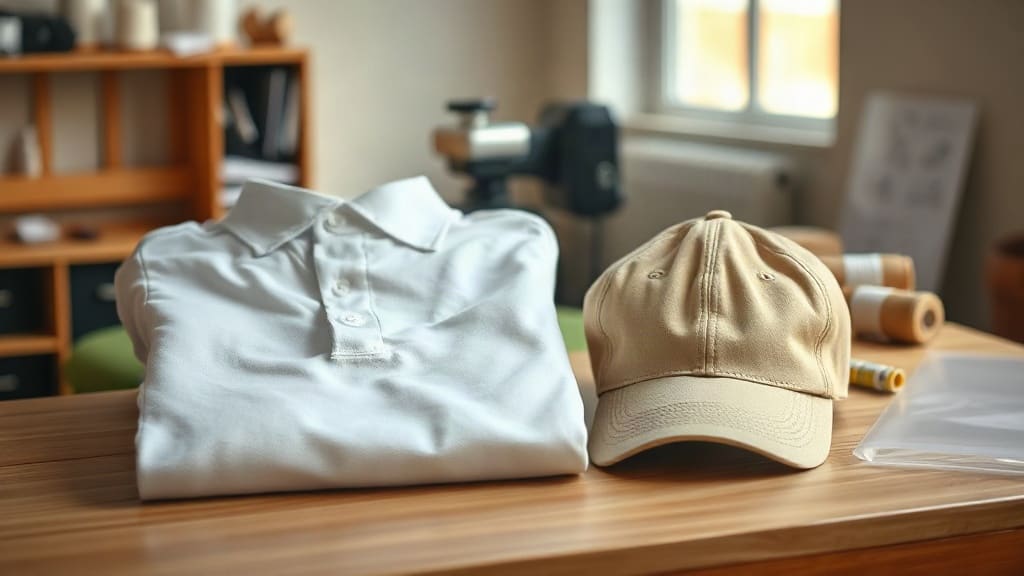
When a shop owner in Ohio asked me to decorate forty performance polos for a sales team, I made a mistake that cost a full day of production. I digitized a detailed logo, stitched it on a lightweight poly blend, and watched the fabric pucker around every letter. The logo had thin lines, small text, and a gradient that thread simply cannot reproduce. Two weeks later, the same client ordered hoodies with a bold, simple mark, and that job ran beautifully on the embroidery machine. The lesson was not that one method beats the other. It was that DTF transfers and embroidery solve completely different problems, and choosing wrong wastes money, time, or both.
What Each Method Actually Does
DTF stands for direct to film. A printer lays down a mirror-image design onto a special film, dusts it with adhesive powder, and cures it. You then press that film onto a garment with a heat press, let it cool, and peel the carrier away. The result is a thin, flexible layer of ink that holds fine detail, gradients, and photographic imagery.
Embroidery is mechanical. A digitizer converts artwork into stitch commands, and a machine sews thread directly into the fabric. The output is textured, dimensional, and famously durable, but it has hard limits on small text, thin lines, and color blending.
Where DTF Transfers Win
Complex Artwork and Full Color
If your design has more than eight or ten colors, soft gradients, or photographic elements, DTF handles it in a single pass. There is no per-color setup, no thread matching, and no digitizing fee. A watercolor logo with twenty shades costs the same to press as a two-color version.
Small Runs and Sample Orders
Embroidery carries fixed costs: digitizing, thread changes, and machine setup. On a five-piece order, those costs dominate. A DTF transfer lets you press one shirt today and fifty next month without renegotiating anything.
Lightweight and Stretchy Fabrics
Performance knits, spandex blends, and thin tri-blends often struggle under dense stitch counts. A properly applied transfer moves with the fabric instead of fighting it.
Where Embroidery Still Leads
Perceived Value and Texture
There is a reason corporate uniforms, golf shirts, and caps so often carry stitched logos. Thread reads as premium in a way that flat ink does not. The raised surface catches light and signals investment.
Extreme Durability
Thread does not crack, peel, or fade the way printed layers can. On workwear that gets washed daily and abused on job sites, embroidery routinely outlasts the garment.
Structured Caps and Heavy Canvas
Curved cap fronts and thick canvas bags are natural embroidery surfaces. Pressing a transfer onto a structured cap is possible but finicky, and the result rarely sits as cleanly as a stitched front panel.
A Practical Comparison
- Setup cost: Embroidery requires digitizing, often a one-time fee per design. DTF requires none beyond preparing the file.
- Color limits: Embroidery is practical up to roughly ten to twelve thread colors. Transfers handle unlimited color.
- Minimum text size: Embroidery needs letters tall enough to remain legible, generally around a quarter inch. Transfers can hold text far smaller.
- Feel: Stitched designs are raised and textured. Transfers are smooth and, when applied well, nearly disappear into the fabric.
- Wash life: Both hold up for years when produced and cared for correctly.
How to Decide for a Specific Order
Start with the garment. Heavy cotton twill, canvas, and structured caps pull you toward embroidery. Lightweight synthetics, stretch blends, and anything with fine detail pull you toward DTF.
Then look at the artwork. Count colors, measure the smallest text, and ask whether gradients matter. If the answer involves more than a handful of colors or any lettering under a quarter inch, embroidery will fight you.
Finally, weigh the quantity and timeline. Rush orders with no digitized file favor transfers because the artwork goes straight to print. Repeat orders with an existing digitized file often favor embroidery, since the setup is already paid for.
Common Mistakes I See in Production
Pressing Transfers at the Wrong Temperature
Every film and adhesive has a temperature window. Too cool, and the adhesive never fully activates. Too hot, and the ink bleeds or the carrier sticks. Test on a scrap garment before running the full order, and check the peel while the transfer is still warm.
Over-Digitizing Thin Lines
A digitizer who tries to preserve every hairline detail will produce a stiff, puckered patch. Good digitizing simplifies. If the design depends on those hairlines, it belongs on a transfer.
Ignoring Fabric Content
High-nylon and coated fabrics behave differently under heat. Some require lower temperatures and longer dwell times, and some need a specialty film. Ask before you press, not after you ruin a dozen jackets.
Can You Use Both on One Garment?
Absolutely, and it often looks intentional. A common combination is embroidery on the left chest and a large DTF print across the back. The stitched chest logo carries the brand, while the back panel handles a detailed graphic or sponsor list that thread could never reproduce cleanly. Just plan the layout so the two elements do not crowd each other, and keep the visual weight balanced between front and back.
Frequently Asked Questions
Is DTF printing more durable than embroidery?
Thread generally outlasts printed ink, especially on garments that see heavy abrasion. That said, a correctly applied DTF transfer on a properly prepared fabric will survive years of normal washing without cracking or peeling. The gap narrows considerably when application is done right.
Can DTF transfers be applied to cotton, polyester, and blends?
Yes. Most standard films work on cotton, polyester, and blends, including many performance fabrics. The variables that matter are heat tolerance and surface texture rather than fiber content alone. Very stretchy or coated materials may need a specialty film or a bonding agent.
How small can text be on an embroidered logo?
As a working rule, keep letters at roughly a quarter inch tall or larger. Below that, thread density makes letters blur together, and thin strokes disappear. If your design includes fine print, either enlarge it or move the whole design to a transfer.
Do I need to digitize artwork for DTF transfers?
No. You need a clean, high-resolution file, ideally with a transparent background and colors set up correctly. There is no stitch file involved, which is one reason transfers are faster to move into production on a tight deadline.
Which method is cheaper for a small order?
For small quantities, transfers usually win because there is no digitizing or setup fee. Embroidery becomes more economical as volume grows, particularly when the design is already digitized and the order repeats.
Making the Call
Neither method is a default. Look at the fabric, the artwork, the quantity, and the deadline, and the answer usually becomes obvious. Keep both options in your shop and you stop forcing designs into a process that was never going to flatter them.